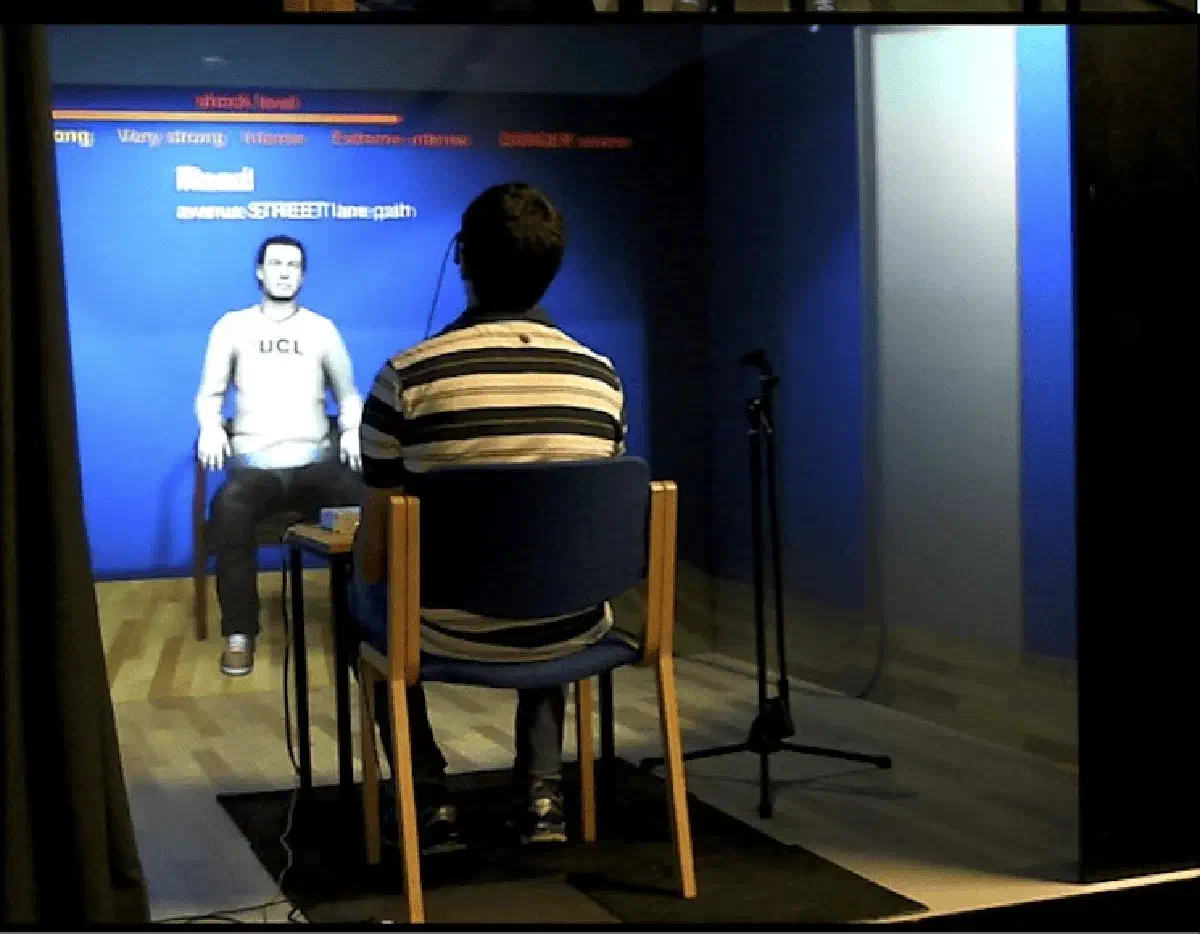
This is my reflection on Would You Give a Virtual Electric Shock to an Avatar? by Mar Gonzalez-Franco and Mel Slater, a Scientific American blog post from April 2019. The authors describe their own study, a VR version of Milgram’s obedience experiment, published in PLOS One. It continues the 2006 study that Slater also discussed in the paper from my previous post.
What I liked #
The main finding is that obedience was not blind. 85% of the participants completed the task, but many of them gave the avatar hints by saying the right answer with a louder voice. The authors describe them as “engaged followers”, people who appear to follow orders but try to get around them. This is different from Milgram’s “agentic state”, where people stop using their own morals and just carry out orders. I find this a more realistic picture of how people behave under authority.
Caring and harming also happened at the same time. Participants who supported the scientific goal of the study continued longer, but they were also the ones who helped the avatar the most. The authors think that helping reduced their stress, so they could keep going. So people can harm someone while they actually care about them. I liked that the article does not reduce this to “good” and “bad” participants.
The VR setup has also improved since the 2006 study. Back then the Learner was a “poorly rendered” virtual woman in a Cave-like system. Here the avatar was based on a real actor recorded with a motion capture setup. Participants knew he was not real and still showed stress and tried to protect him, which I see as a strong sign of plausibility illusion. 85% completed the task here compared to 74% in 2006, but the two studies are set up differently, so I would not compare these numbers directly.
The last point I liked is the cost of resistance. Stress was measured before and after the experiment. Even participants who cheated were more stressed at the end. According to the authors, people who continue while quietly resisting carry more stress than people who simply quit. I had not thought about resistance as something that costs the resister.
What I did not like / what caught my attention #
The subtitle says that people who unwillingly obey “still experience trauma”. But in the text the authors write that “in our experiment, we did not get that far”. They only measured stress before and after. Stress and trauma are not the same thing, so the subtitle promises more than the study shows.
The jump from the lab to real life is also big. The article starts with organized resistance against repressive governments and says the results challenge views on obedience that go back to the Nuremberg trials. The participants were students in a lab who knew the victim was virtual. I like the engaged follower idea, but I am not convinced it carries over to officials under a real regime.
Finally, the main evidence for resistance is a louder voice, which the authors call cheating “even if unconsciously”. If it is unconscious, I am not sure it counts as resistance. A louder voice could also come from nerves or from wanting to be heard clearly. The article does not explain how they separated these, so I would have to read the PLOS One paper to judge it.
My take #
Together with the first paper, this article shows what VR offers to psychology: an ethical way to study situations we cannot create in reality, with results that are more detailed than a simple “obeyed or not”. But as a short blog post written by the researchers about their own work, it gives strong conclusions with almost no numbers. I trust the idea more than the way it is presented here.
Reference: Gonzalez-Franco, M. and Slater, M. (2019, April 12). Would You Give a Virtual Electric Shock to an Avatar? Scientific American (blog). Full study in PLOS One: https://doi.org/10.1371/journal.pone.0209704